

My alarm went off at 5:00 a.m sharp.
There’s something about that piercing beep that always gets my heart racing, even after all these years. Honestly, my body clock would probably wake me up anyway, but I still set it just in case.
Outside, Hamilton and the surrounding area were still fully wrapped in the dark, quiet embrace of the night. According to the calendar, the sun was supposed to be up, but there wasn’t a hint of daylight yet. After sorting out my morning routine, I headed into the kitchen.
Once I’m in there, time just seems to slip away. At 6:00 a.m., I started tossing some bread into the toaster. For me, there’s nothing more relaxing than losing myself in thought while enjoying the rich aroma and taste of fresh filter coffee. As a Palakkad Tamil Brahmin from Kerala state of India , it’s hard to believe I’ve been living here in Canada for forty-five years now.
Though I put away my sacred thread after getting married and picked up habits like smoking, having an occasional drink, and eating meat, my early morning routine has stayed intact. That ritual of filter coffee paired with the traditional Suprabhatham prayers playing softly in the background still keeps me grounded. It’s a habit I just can’t shake.
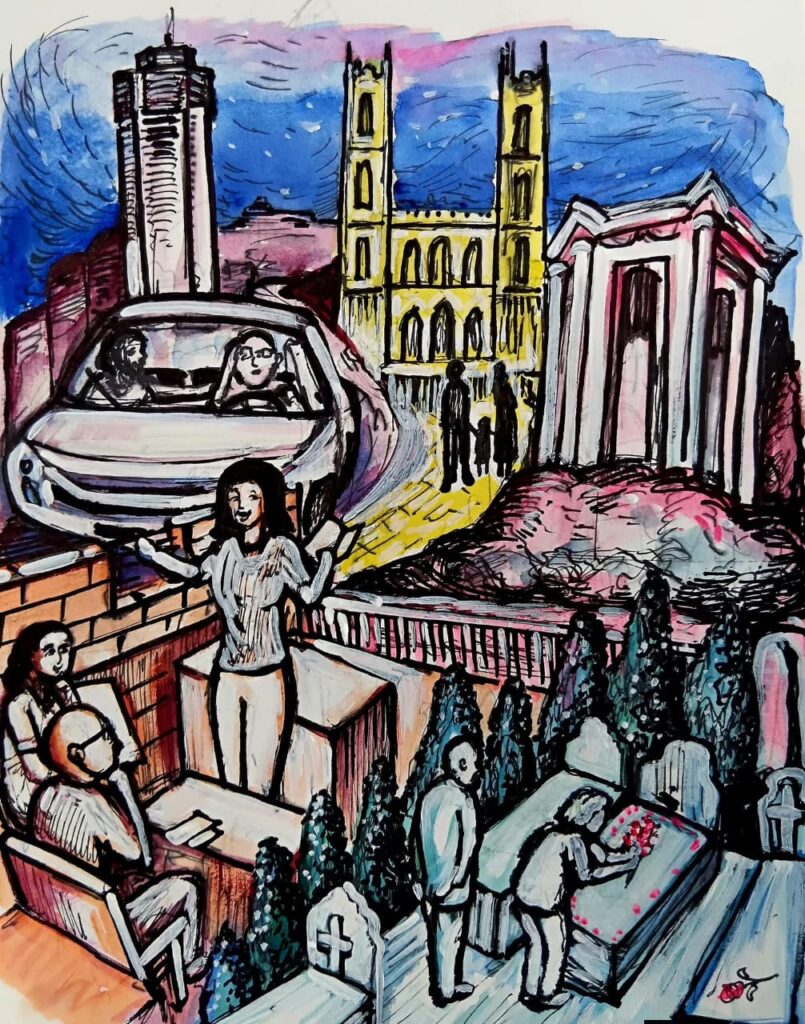
I’m sixty-five now. I’ve been retired for exactly two months. My wife, Susanna, who is originally from Sri Lanka, retired at the same time—a joint retirement. Our only daughter, Melissa, whom we lovingly call Mel, lives in Montreal and works as a music teacher. She married a local French-Canadian guy. It’s a beautiful mix of cultures.
They have an eight-year-old daughter named Angel. She speaks only French.
Every now and then, she comes over to stay with us for a couple of days, but Susanna and I really struggle to talk, play, or fully connect with her. The barrier is that neither of us knows French. That’s our big dilemma right now.
I was busy spreading butter over a perfectly crisp piece of toast, licking the leftover butter off the spoon, when Susanna walked into the kitchen. She crept up behind me, gave me a tight hug, and kissed my cheek.
I caught the familiar, comforting scent of her perfume. Looking at her, I could tell she felt like the luckiest woman in the world. Let’s be real—finding a husband who actually knows his way around a kitchen and loves to cook is like winning the lottery for any woman. That’s just a universal truth.
“Subbu, hurry it up! If we want to get to Melinda’s place, we need to hit the road by 7:30. The morning rush-hour traffic is going to be brutal. And knowing you, you’ll take forever in the shower with your whole traditional bathing and prayer routine!”
Susanna was just teasing, but she wasn’t wrong. I do like to take my sweet time in the shower; it’s a lifelong habit. I still remember back home, how my grandmother would give me oil massages followed by a steaming hot bath.
Then, with holy ash smeared on my forehead, I’d sit down to a breakfast of piping hot idlis and sambar before rushing to school. Back then, people used to make fun of it, but today, idli and sambar are celebrated globally as one of the healthiest breakfasts.
I guess it’s true what they say: the grass is always greener on the other side, and we only appreciate things when the rest of the world does.
Melinda is my wife’s closest friend. She’s always the one giving Susanna all sorts of advice—both requested and unrequested. I couldn’t help but wonder what kind of advice she had in store for us today.
I poured two cups of coffee, put out the buttered toast and some biscuits, and decided to quicken my pace. Susanna is super efficient and gets things done in a flash. She’s always been that way. On the other hand, I tend to get stuck overthinking things.
Susanna always says, “Overthinking is just a waste of time, but then again, if you don’t think at all, you’re clueless.” Smiling at the thought, I got up to take my shower.
Susanna usually calls the shots around the house, and I’ve never really had an issue with that. Yesterday, she floated an idea: why don’t the two of us learn French? It actually made sense. Now that we’re retired, we have plenty of time on our hands. But Susanna is the type who won’t just lay everything out at once. You have to gently pry it out of her, and I think she secretly enjoys that little game.
As I was driving, she started dropping hints with a long preamble. Apparently, it was Melinda who had put this thought into her head. I knew the drill: I was supposed to take the bait and start asking questions. That’s exactly what she wanted. She glanced over at me, waiting. I smiled and gave her the opening she was looking for.
“Alright, so what did Melinda say?” I asked. She beamed.
“Well, there’s an old saying: ‘Where there’s a will, there’s a way!’ If we really want to do this, we just have to put in the effort. That’s the only way it’ll happen.”
Susanna was still holding back the core of her plan. I tried, unsuccessfully, to guess what was coming next, and my curiosity was killing me. She was clearly enjoying my suspense.
“Come on, Susanna, sweetheart, stop stretching it out. Just tell me what’s on your mind,” I pleaded, glancing away from the road for a second.
She opened her purse, pulled out a small piece of paper with something jotted down in red ink, and held it up.
“Keep your eyes on the road, Subbu, or you’re going to crash the car! Look, in two weeks, we are going to France. To be exact, we’re heading to Montpellier, France.”
She looked at me and laughed. I was completely thrown off.
“For what? I’m not going anywhere. I have things to take care of around the house, and I have golf dates lined up with the guys. I’ve got a schedule. Why don’t you go ahead to France with your girlfriends? Count me out.”
When I said that, she gave me a look that was definitely not filled with love. Recognizing the danger zone, I decided to pivot instantly—a survival skill I’ve mastered over the years.
“Melinda has been talking to me about this for a while,” Susanna continued, shifting back to her gentle tone. “The best way to pick up French quickly is to live right there in France. Her friend studied at a language college in Montpellier, and the school arranges everything. We’ll be doing a homestay with a local couple who speak absolutely no English. It’s for two or three months. We’ll attend classes from 9:00 a.m. to 5:00 p.m., but only four days a week, so we’ll have long weekends. The rest of the time, we’ll be forced to talk to our hosts in French. With no safety net of English, we’ll pick it up in no time.”
I looked at her, still a bit skeptical.
“And during our free time, we can hang out with our hosts, explore the local spots, and immerse ourselves. We can even cook our own food, or if we pay a bit extra, they can provide meals as part of a package. So, Subbu, what do you think?”
Looking at her face, I knew it was a done deal. Susanna had already mapped everything out.
“I’ve actually done all the research,” she added. “I already called the college, spoke to a travel agent, and even cleared it with Mel.”
Well, what opinion could I possibly offer now? The decisions were made, and there was no point in arguing. I just kept my mouth shut and focused on the highway.
In fairness, she had a point. Our granddaughter only speaks French. If we wanted to talk to her, play with her, and be a real part of her life, learning the language was our only option. If it were anything else, I might have tried to wiggle out of it.
Our daughter had moved to Montreal years ago to study music at McGill University. After graduating, she decided to stay there. She fell in love with a French-Canadian guy, and eventually, they had Angel. His entire family speaks only French, so naturally, our granddaughter grew up speaking it too. They only come down to visit us for a weekend here and there. While cultural mosaics are beautiful, they definitely come with their own unique puzzles.
By the time Susanna and I boarded our flight from Toronto to Montreal, it was already 7:00 p.m. The twilight was gently giving way to the night sky. The plan was to spend a few days with our daughter and her family in Montreal, and then fly directly to Paris, followed by a train ride down to Montpellier. Susanna had organized every single detail.
Plus, we had years of travel experience under our belts, which made things easier. The homestay was booked, and our classes were set to start two days after we arrived. We were going to be there for three months. We had quickly tied up all our loose ends back home in Hamilton.
Thanks to the digital age, you can manage pretty much everything online from anywhere in the world—you just need to know your way around a computer. The thought of being able to fluently speak French with our little granddaughter in three months filled us with a sudden wave of excitement.
The moment we walked into Mel’s house in Montreal, Angel ran up to us, chattering away excitedly in French. Susanna shot me a look. That glance held a silent, triumphant ‘See? I🙏 told you my decision was right.’ I scooped my granddaughter up in a big hug, carried her over to a chair, and sat down. Holding her close, I kissed the top of her head and said to her in English.
“Sweetheart, Grandpa and Grandma will do anything for you. We are going to France just to learn your language. We’ll explore the country, learn to speak like you, and when we get back, we’ll tell you all the best stories.”
As I stood up, Mel slipped a small package into my hand. I opened it to find a stack of Canadian dollars. When I pulled her into a hug, I could see tears welling up in her eyes.
From Montreal, there are direct flights to Paris, which is convenient.
Montreal itself is predominantly French-speaking; this part of Canada historically grew out of a French colony. Because of that, Montreal is steeped in French culture, European architecture, and incredible cuisine. It’s located in the province of Quebec.
Even though the French forces left long ago and Quebec became a vital part of Canada, there’s still a strong undercurrent of regional nationalism, with occasional political pushes for sovereignty. Over the years, the federal government has granted the province special status to maintain harmony.
They even have their own provincial political parties that dominate local elections. It often feels like politicians play on regional anxieties to stay powerful and advance their own agendas.
Montpellier turned out to be a gorgeous city in the South of France. It’s a place where history meets modernity, standing proudly not too far from the Mediterranean coast. It’s a bustling hub filled with international students and tourists eager to see the historic architecture.
Interestingly, after Algeria gained independence from France, a massive wave of French expatriates, military personnel, and their families relocated and settled down right here in this city. By the time our train arrived from Paris, evening had set in. We hailed a cab and drove straight to our homestay.
Our host was a man named Jean, who looked to be around fifty. In English, of course, the name is written as ‘Jean’, but here it’s pronounced John. His wife, Annabelle, looked to be in her late thirties.
They welcomed us with incredibly warm smiles. True to the contract, they spoke to us strictly in French—which was exactly what we bargained for.
However, as we settled in, I realized that Annabelle was actually fluent in English and Arabic alongside French. Susanna and Annabelle hit it off instantly, holding hands and chatting like old friends. Annabelle’s father had been a French soldier stationed in Algeria back when it was a French colony, which is how her parents learned Arabic and passed it down to her.
Annabelle loved Arabic music, dance, and food. Jean, on the other hand, was a quintessential Frenchman, though as we conversed, I realized he could understand and speak a fair bit of broken English.
Even though Annabelle was younger, there was an effortless grace and sophistication about her that was truly captivating. Tall, fair, and slender with shoulder-length hair, she moved with the poise of a model. Her eyes held a deep, quiet wisdom born of experience.
She spoke selectively but eloquently, and her ability to anticipate everyone’s needs set her apart. Jean was a jovial, lighthearted man who loved a good joke. Even though he knew some English, his insistence on sticking to French made our evenings together both highly entertaining and educational.
We all gathered around the table for dinner. In keeping with French tradition, Annabelle first brought out an exquisite spread of local wine and cheese. Dinner in France isn’t just a meal; it’s an event that easily lasts an hour and a half, filled with lively conversation.
They recap everything that happened during the day, believing that sharing a meal is the ultimate way to strengthen bonds. People in France really seem to value a healthy work-life balance. No one overworks themselves; moderation is key.
Annabelle worked only three or four evenings a week. Jean worked from home most of the time, only commuting to the office once a week or so. They truly knew how to enjoy life. I couldn’t help but feel that back in Canada, we miss out on this rhythm, except maybe in some of the quieter, remote provinces.
To outsiders, the French can sometimes come across as slightly arrogant or aloof due to their formal speech and body language. It’s just their cultural demeanor, and I don’t think it’s intentional. I doubt they even realize that others perceive it as arrogance.
But that’s the beauty of travel—it exposes you to different ways of living and understanding human nature.
By nature, we humans love comfort. But history shows that those who step out of their comfort zones are usually the ones who truly thrive. When you’re pushed into a corner with no other options, you unlock capabilities you never knew you had. That’s exactly what was happening to us. Jean and Annabelle spoke nothing but French around us all day.
Initially, it was incredibly frustrating and exhausting, but because we had no choice, Susanna and I were forced to adapt. It was a fascinating lesson in human survival and linguistic immersion. I realized this total-immersion model could be applied effectively to learn so many other skills in life.
Between our structured classes at the language college—which ran seamlessly from 10:00 a.m. to 4:00 p.m., five days a week—and our conversations at home, our French was improving rapidly. My classmates were from all corners of the world, having moved to France for work or higher education.
Listening to their stories of hardship, resilience, and their fierce drive to succeed was incredibly humbling. Every day brought a new perspective.
In the evenings, Susanna and I would often go out exploring, sometimes accompanied by Jean, sometimes Annabelle, or both. But one evening, when we returned to the house, our hosts were out. Seizing the rare quiet moment, I felt like going out for a solo walk, but Susanna stopped me.
“Subbu, there’s something I need to tell you. I don’t know if you remember, but four months ago on my birthday, one of the gifts Mel gave me was a home DNA ancestry kit. You remember how I had to collect a saliva sample in a test tube and mail it back to the lab?”
I sat down, my eyes fixed on her, suddenly anxious about what she was leading up to.
“The results came back a month ago,” she said quietly. “I didn’t tell you right away. The report shows that I am nearly fifty percent European by blood. As you know, my grandparents fled Sri Lanka as refugees and lived in a tiny village not far from here for about three years. My mother was around twenty at the time. She always told me she met and married my father here, and right after the wedding, they immigrated to Canada as refugees. She used to say my father fell head over heels for her because she was beautiful and insisted on marrying her. My father was also from a Sri Lankan refugee family. So, Subbu… how is it possible that half my DNA is European?”
I stared at her in utter disbelief. The weight of what she was saying felt surreal.
“This trip wasn’t just about learning French or sightseeing,” Susanna confessed. “I planned this whole journey to investigate my roots. Since my mother has passed away, I can’t ask her, and I can’t bring myself to question my father at his age. I wanted to tell you first, but decided to wait until we were here. I had actually emailed Annabelle about this before we arrived. Knowing her father was in the military, I thought he might have connections to help look into local records. Plus, the village my mother lived in is very close to Montpellier. Annabelle tracked it down and even did some preliminary digging before we landed. I’m sorry for keeping it a secret, Subbu. Because it was such a deeply personal search into my origins, I wanted to keep it private until I had facts. I hope you can understand.”
“Have you actually been to the village?” I asked, amazed by her resourcefulness. “It’s been what, sixty-five years? Finding anything must be nearly impossible. But wow, Susanna… you should have told me.”
Susanna squeezed my hands tightly, and I held hers back.
“Annabelle and I have driven out there twice already. We talked to several elderly locals. Sadly, most people who might have personally known my grandparents’ generation have passed away. But we did manage to locate the exact house where my grandparents stayed. A few old-timers living around there shared some stories… though I don’t know how much of it is absolutely true.”
I sat there spellbound, feeling like I was listening to a mystery novel. Looking at my wife, a profound sense of respect washed over me. I felt incredibly proud of her determination.
“We need to go somewhere today,” Susanna said, her voice trembling slightly. “There’s an old cemetery nearby. We’re going to visit a grave belonging to a man named Albert Pierre. He passed away around the exact time my mother’s family left France—it was a tragic motorcycle accident. The local stories suggest my mother was deeply in love with Albert back then. Whether it’s the whole truth or not, I don’t know. But I want to go there and pay my respects. Will you come with me?”
“Of course, Susanna. I’m with you all the way, no matter what,” I said, pulling her into a tight hug as she began to cry.
“I’ve already paid the cemetery caretaker to clean up the plot, repaint it, and lay down new tiles next month,” she whispered. “Albert didn’t have any family left; he was an orphan. Local rumor has it that the original headstone was actually paid for by my mother before she left. I choose to believe it. We have to start somewhere, right? We believe in so many things in life that we can’t fully prove. I’m never going to mention this to my father. At his age, I couldn’t bear to see him hurt.”
The next day, the three of us went to the quiet cemetery. We laid fresh red roses on the grave and prayed. We met with the caretaker to ensure the restoration work would be taken care of. On the drive back, Susanna rested her head on my lap, weeping silently.
There’s an old saying that a father is whoever a mother points to. Decades had passed, leaving this profound mystery of Susanna’s lineage completely locked away by time.
It made me reflect on how the world is full of hidden truths.
There are so many people walking among us, carrying heavy, unspoken secrets deep within their hearts, living completely ordinary lives on the surface. Every life is bound to have its own shadows and mysteries.
Sometimes, I thought to myself, it’s better not to dig too deep.
Cover: Wilson Sarada Anand